
Stochastic Oscillator: Complete Guide to %K, %D, and Trading Signals
The stochastic oscillator has been helping traders anticipate market turns since the 1950s, and in 2026’s algorithm-driven markets, it remains one of the most reliable tools for timing entries and exits. Whether you’re scalping EUR/USD or swing trading the S&P 500, understanding how this momentum indicator works can sharpen your edge.
Stochastic Oscillator Overview
The stochastic oscillator is a momentum indicator that compares a security’s closing price to its recent high low range over a specified lookback period. In simple terms, it answers one question: where did price close relative to its recent highs and lows?
The stochastic oscillator measures momentum by outputting values between 0 and 100. When readings approach 100, the current price sits near the top of the recent price range, suggesting overbought conditions. When readings drop toward 0, price trades near the lowest price of that range, indicating oversold conditions.
This stochastic indicator works across virtually all financial markets:
- Stocks (individual equities and ETFs)
- Forex pairs like EUR/USD and USD/JPY
- Indices such as the S&P 500 and Nasdaq
- Cryptocurrencies including BTC/USD and ETH/USDT
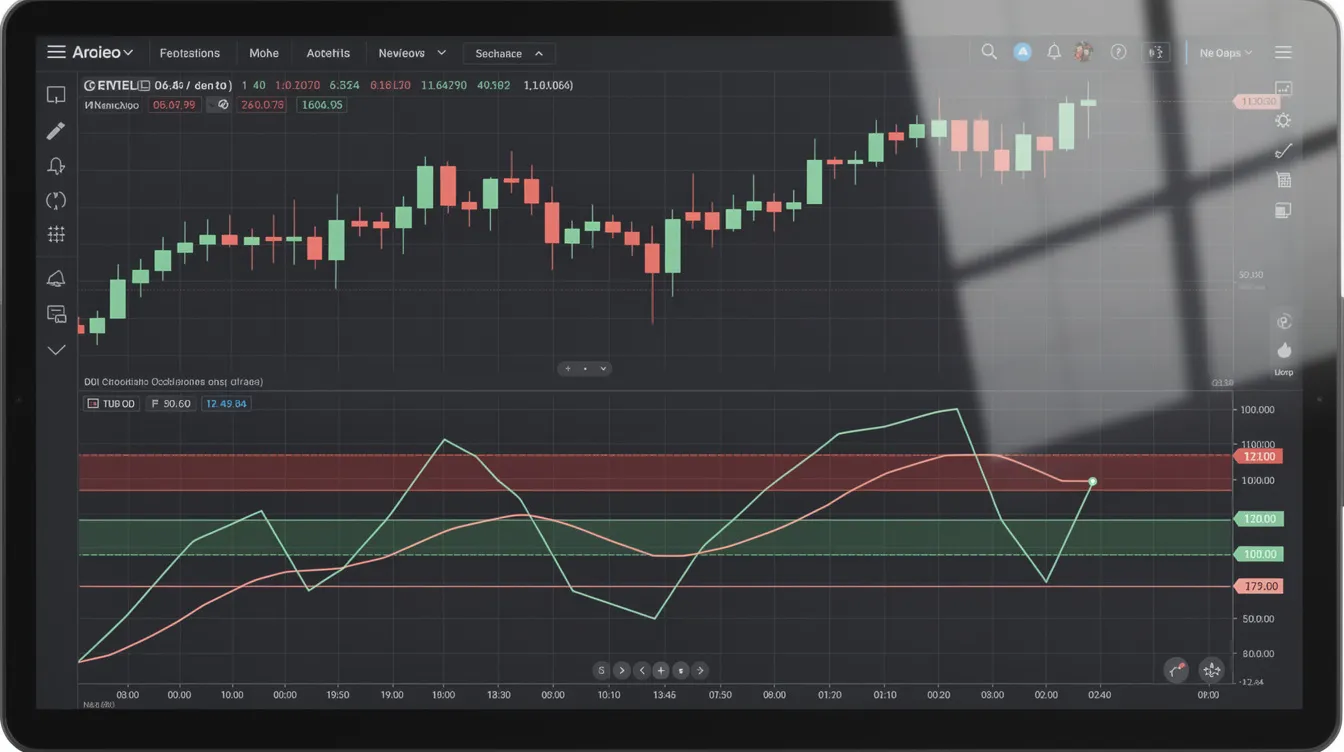
The oscillator displays two lines on your chart. The k line (%K) represents the fast, raw momentum reading, while the signal line (%D) smooths that data as a moving average of k. Different variants exist: Fast, Slow, and Full stochastic, each suited to different trading styles from scalping to position trading.
History and Development of the Stochastic Oscillator
Dr. George C. Lane developed the stochastic oscillator in the late 1950s while analyzing U.S. stock markets. His breakthrough observation was elegantly simple: momentum changes direction before price does. By tracking where closes landed within their recent range, Lane could spot potential trend reversals early.
Lane famously stated that the indicator “doesn’t follow price, it doesn’t follow volume or anything like that, it follows the speed or the momentum of price.” His original work focused on daily charts of NYSE stocks throughout the 1960s and 1970s, where %D-line divergences proved remarkably effective at foreshadowing tops and bottoms.
Key historical milestones:
- 1950s: Lane develops the original stochastic concept during post-WWII market expansion
- 1970s-1980s: The indicator gains traction in futures and options markets; Slow and Full variants emerge to reduce whipsaws
- 1990s-2000s: Computerized platforms like MetaStock and TradeStation make stochastic analysis accessible to retail traders
- 2020s: Modern platforms including TradingView, MetaTrader, and Thinkorswim integrate fully customizable stochastic tools for algorithmic and discretionary trading
Stochastic Oscillator Mechanics: %K, %D, and Core Formula
Understanding how the stochastic oscillator is calculated requires grasping one core concept: it positions the last closing price within the recent trading range as a percentage.
The stochastic oscillator formula for %K is:
%K = [(Current Close − Lowest Low) / (Highest High − Lowest Low)] × 100
Here’s what each component means:
- Lowest Low: The minimum price over the lookback period (typically 14 bars)
- Highest High: The maximum price over the same period
- Current Close: The most recent closing price
The %D line is simply a 3-period simple moving average of %K, creating a smoother signal line that reduces noise.
Practical example:
Consider a stock on a 14-day chart where:
- Highest price over 14 days = 120
- Lowest price over 14 days = 100
- Today’s close = 118
%K = [(118 - 100) / (120 - 100)] × 100 = (18/20) × 100 = 90
This reading of 90 indicates the market price closed near the upper extreme of its recent range, suggesting strong upward momentum.
Interpretation guidelines:
- Values near 0: Close hugging the lowest point of the range (potential exhaustion of downward momentum)
- Values near 100: Close near the highest point (potential exhaustion of upward momentum)
- Values around 50: Close sitting at the middle of the range (neutral momentum)
The classic default stochastic oscillator settings of (14, 3) work identically across timeframes whether you’re using 15-minute, 1-hour, daily, or weekly charts.
Fast, Slow, and Full Stochastic Oscillator Variants
The three main stochastic versions differ in their smoothing approach, creating a trade-off between reaction speed and signal reliability.
Fast Stochastic Oscillator
The fast stochastic oscillator uses minimal smoothing:
- Fast %K: The raw calculation over your chosen lookback (e.g., 14 periods)
- Fast %D: A 3-period SMA of Fast %K
Common default: Fast (14, 3)
This variant reacts quickly to price changes, making it suitable for short-term scalping during volatile sessions. However, it produces choppy signals and more frequent false crossovers in trending markets.
Slow Stochastic Oscillator
The slow stochastic oscillator adds an extra smoothing layer:
- Slow %K: A 3-period SMA of Fast %K
- Slow %D: A 3-period SMA of Slow %K
Common default: Slow (14, 3)
Most traders prefer this version. It generates cleaner lines with fewer crossovers, making it ideal for swing trading where reliability matters more than speed.
Full Stochastic Oscillator
The full stochastic oscillator offers maximum customization:
- Full %K: Fast %K smoothed with a user-defined moving average period (e.g., 3 or 5)
- Full %D: Another SMA of Full %K using a separate user-defined period
Typical setting: Full (14, 5, 5)
This variant lets you fine-tune sensitivity per asset shorter smoothing for liquid forex scalps, heavier smoothing for noisy crypto charts.
When to use each variant:
- Fast: Scalping and very short-term intraday entries during news-driven volatility
- Slow: Daily and multi-day swing trades on stocks and indices
- Full: Position trading in range bound markets or customizing for specific asset volatility
How to Read Stochastic Oscillator Signals
The stochastic oscillator forms trading signals through its position on the 0-100 scale and through interactions between the %K and %D lines.
Overbought and Oversold Levels
Standard thresholds help identify overbought and oversold conditions:
- Overbought threshold: Above 80 (or 85 for stricter filtering)
- Oversold threshold: Below 20 (or 15 for stricter filtering)
Critical point: Overbought doesn’t automatically mean “sell now,” and oversold doesn’t mean “buy now.” In a bullish trend, stochastic can remain overbought for extended periods as price continues climbing.
%K-%D Crossovers
Crossovers generate signals that help traders time entries:
- Bullish stochastic crossover: %K crosses above %D from below in oversold levels a potential buy signal
- Bearish crossover: %K crosses below %D from above in overbought territory a potential sell signal
- Crossovers near the 50 level carry less significance and are often ignored
Trend Context Matters
Using the stochastic oscillator effectively requires aligning signals with the broader trend:
- In uptrends: Focus on stochastic turning up from oversold (buy-the-dip opportunities)
- In downtrends: Focus on stochastic turning down from overbought (sell-the-rally setups)
A simple filter: use a 200-day moving average to define trend direction. Only take oversold buy signals when price trades above the 200-day MA.
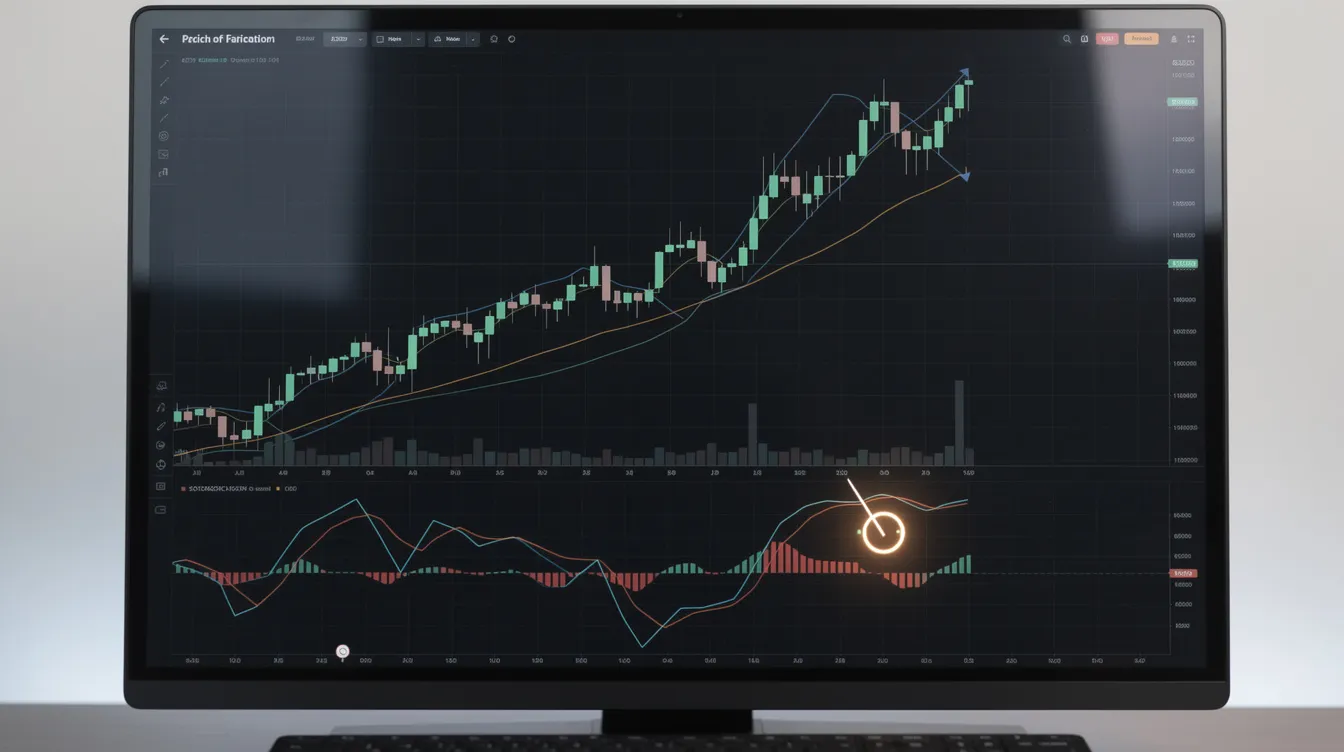
Example: In October 2024, the S&P 500 traded above its 200-day MA when stochastic dipped below 20 amid post-election volatility. As %K crossed up through %D around the 15-20 zone, swing traders found a textbook dip-buying opportunity in a bullish trend.
Divergences and Lane’s Bull/Bear Set-Ups
Divergence signals represent disagreement between price action and oscillator momentum often the most powerful warning signs the stochastic provides.
Bullish Divergence
Bullish divergence forms when:
- Price makes a lower low
- Stochastic makes a higher low
This pattern signals weakening downward momentum and potential for a bullish reversal. A bullish divergence occurs most reliably at established support zones.
Bearish Divergence
Bearish divergence occurs when:
- Price makes a higher high
- Stochastic makes a lower high
Bearish divergence forms as upside momentum fades, warning of potential trend reversals to the downside.
Lane’s Set-Ups
George Lane developed specific patterns he called “set-ups” for anticipating moves:
- Bull set-up: Price forms a lower high while stochastic forms a higher high, suggesting internal strength before an advance
- Bear set-up: Price forms a higher low while stochastic forms a lower low, indicating internal weakness before a decline
Practical example: On the EUR/USD 4-hour chart in January 2025, price hit a fresh low amid delayed Fed rate cut expectations. Yet stochastic’s %K trough rose higher than its previous low a classic bullish divergence. The pair subsequently rallied 200 pips as momentum caught up to what the oscillator had signaled.
Remember: Bullish and bearish divergences are early warnings, not standalone triggers. Confirm them with support/resistance breaks or %K-%D crossovers before entering trades.
Stochastic Oscillator Trading Strategies
Effective trading strategies using the stochastic oscillator work best when combined with trend analysis, support/resistance levels, and proper risk management.
Range-Trading Strategy
For range bound markets where price oscillates between clear boundaries:
- Apply Full stochastic (20, 5, 5) to identify overbought and oversold swings
- Enter long when stochastic rises back above 20 from oversold conditions near support
- Enter short when stochastic falls below 80 from overbought near resistance
- Target the opposite side of the range with stops beyond the recent swing extreme
Trend-Following Strategy
For trending markets, filter signals with a longer moving average:
- Use 100-day or 200-day SMA to define trend direction
- In uptrends (price above MA), only take stochastic oversold signals %K crossing above %D below 20
- In downtrends (price below MA), only take overbought signals %K crossing below %D above 80
Example: BTC/USDT on the daily chart traded above its 200-SMA in Q1 2025. When stochastic dropped below 20 and generated a bullish crossover, traders who bought the dip captured a 15% rally over the following weeks.
Multi-Timeframe Approach
Align higher and lower timeframes for precision:
- Daily chart: Define overall trend and key zones
- Hourly or 15-minute chart: Time entries when stochastic aligns in both timeframes
This approach worked well for NVDA in 2024’s uptrend, where daily stochastic oversold readings synced with 1-hour bullish crossovers near Fibonacci 61.8% retracements.
Combining With Other Technical Indicators
Strengthen stochastic signals with complementary tools:
- Bollinger Bands for squeeze breakout confirmation
- VWAP for intraday directional bias in forex trading
- OBV volume confirmation when acting on divergence signals
- Chart patterns like double bottoms to validate oversold bounces
Adjusting Stochastic Settings for Different Markets and Timeframes
Parameter adjustments create a trade-off: shorter periods increase sensitivity but generate false signals more frequently.
Lookback Period Guidelines
|
Market Condition |
Lookback Period |
Use Case |
|---|---|---|
|
High volatility, intraday |
5-9 periods |
Crypto scalping, earnings plays |
|
Standard swing trading |
14 periods |
Daily forex, stock swings |
|
Weekly charts, stable stocks |
21-28 periods |
Position trading, indices |
Smoothing Variations
For Full stochastic, smoothing affects signal frequency:
- (14, 3, 3): More responsive, suited for liquid forex majors
- (14, 5, 5): Fewer crossovers, better for choppy BTC charts
Asset-Specific Tuning
- Forex majors (EUR/USD, USD/JPY): Slightly shorter periods work well due to 24-hour liquidity
- Volatile growth stocks: More smoothing reduces noise during erratic price swings
- Index futures and ETFs: Classic (14, 3, 3) or (14, 5, 5) performs reliably on 1-hour and 4-hour charts
No universal “best” setting exists. Backtest parameter combinations on historical data spanning 2018-2025 to capture various market dynamics COVID volatility, 2022 bears, and 2023-2025 AI-driven bulls. Then forward-test to match your personal risk tolerance.
Advantages and Limitations of the Stochastic Oscillator
The stochastic oscillator offers powerful momentum insights but comes with clear constraints that traders must understand.
Advantages
- Clearly highlights overbought and oversold conditions on a consistent 0-100 scale
- Provides early warning of momentum shifts compared with lagging indicator tools like moving averages
- Excels in sideways markets around well-defined support/resistance where 70-80% of signals historically align
- Available on all major platforms with fully customizable parameters
- Works identically across stocks, forex, crypto, and futures
Limitations
- Can generate false signals frequently in strong, one-directional market trends
- Overbought readings can persist for weeks in powerful bull markets (and oversold in bear markets)
- Divergences may appear early and fail if price continues trending without meaningful pullback
- Not designed to identify overbought and oversold levels during volatile markets with extreme momentum
Risk Management Guidelines
- Combine stochastic with at least one trend filter (moving average) and price-based level (support/resistance)
- Set stop-losses based on recent swing highs/lows rather than oscillator readings
- Treat stochastic as one component of broader technical analysis, not a standalone system
Comparison With Other Momentum Oscillators
The stochastic oscillator is a momentum tool among several options, each with distinct characteristics suited to different purposes.
Stochastic vs. RSI
|
Feature |
Stochastic |
RSI |
|---|---|---|
|
Measures |
Close relative to high-low range |
Speed/magnitude of gains vs. losses |
|
Typical thresholds |
20/80 |
30/70 |
|
Best for |
Short-term timing, range trading |
Momentum velocity, trend strength |
RSI functions as a lagging indicator compared to stochastic’s faster signals. Many traders use both: only taking stochastic buy or sell signals when RSI confirms (e.g., RSI above 40 for buys).
Stochastic vs. MACD
MACD tracks moving average convergence/divergence and is unbounded, making it better for defining trend direction over extended periods. Stochastic’s bounded 0-100 scale better pinpoints short-term extremes. The combination works well: use MACD to establish trend, stochastic to time pullback entries.
Stochastic vs. CCI
Commodity Channel Index measures deviation from a statistical mean with unbounded values. This complicates threshold interpretation compared to stochastic’s intuitive 20/80 zones. Among momentum oscillators, stochastic remains more accessible for traders learning technical indicators.
Practical Tips and Best Practices for Using the Stochastic Oscillator
Disciplined application matters more than finding perfect parameters. Context and testing determine success.
Implementation Checklist
- Always check higher-timeframe trend before acting on stochastic signals
- Avoid overtrading every crossover prioritize signals near key support/resistance
- Pause during major macro events (FOMC decisions, CPI releases) where whipsaws spike significantly
- Never rely on stochastic alone to identify potential trend reversals
Getting Started
- Begin with standard settings (14, 3, 3) on daily charts for one month
- Journal every signal alongside actual price outcomes
- Track win rates and drawdowns before risking real capital
- Gradually add confirmation tools (MA, volume, VWAP) based on observed results
- Backtest across 2020-2025 data to capture both volatile markets and trending markets phases
Final Perspective
The stochastic oscillator remains one of the most versatile tools for identifying overbought and oversold levels and timing entries within established plans. Its power lies not in generating standalone buy signal or sell signal triggers, but in adding momentum context to well-defined setups.
Start with default settings, observe how price responds to overbought and oversold threshold zones in your chosen markets, and build a systematic approach that fits your trading styles. The stochastic indicator rewards patience, discipline, and integration with broader market analysis not blind signal-following.